🌷 The Tale of Two Tulip Towns in America

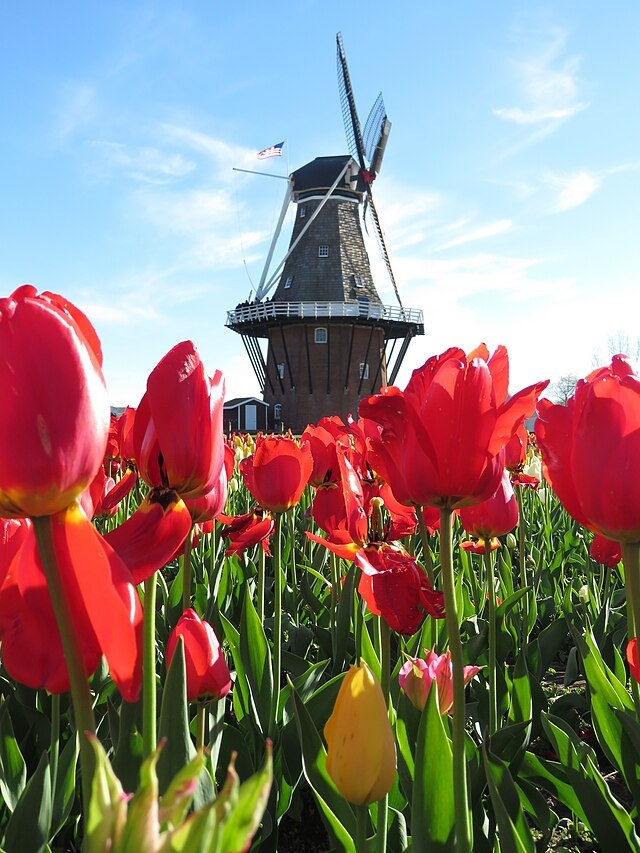
De Zwaan — the oldest authentic working Dutch windmill in the United States — rises above tulips in Holland, Michigan, where a small-town spring tradition began nearly a century ago.
From 1800s farmland to a 1927 classroom — how two spring traditions quietly bloomed.
Every April, something remarkable happens in two very different corners of America.
One is a charming lakeside town where tulips spill into the streets, windmills turn slowly and wooden shoes click along parade routes.
The other is wide open farmland — mountains in the distance, endless rows of color stretching to the horizon, photographers standing quietly at sunrise.
They look completely different. They feel completely different.
And yet… both started in the simplest way imaginable.
One began with a single teacher and a classroom idea. The other began with farmers planting bulbs in good soil.
Today, both draw hundreds of thousands of visitors each spring — but their origins could not be more different.
🌷 Holland, Michigan — The teacher who planted a town
Long before it became one of the most beloved tulip festivals in America, Holland, Michigan was simply a Dutch-American town along the shores of Lake Michigan.
In 1927, a local high school biology teacher had a simple idea.
She believed tulips would beautify the town — and teach students something meaningful at the same time.
So she ordered 100,000 tulip bulbs.
Students helped plant them. Residents joined in. Streets slowly filled with blooms the following spring.
No one expected what happened next.
People came to see them.
First nearby towns. Then visitors from across Michigan. Then travelers from neighboring states.
Before long, the town embraced the moment — creating what would become one of America’s most recognizable spring traditions.
What started as a classroom project became a community celebration… and then a generational one.
Today, families still carry the tradition forward each year:
Children dancing in wooden shoes. Parades rolling through tulip-lined streets. Residents scrubbing sidewalks in traditional Dutch fashion. Entire neighborhoods planting bulbs year after year.
What began with one teacher is now supported by hundreds of families who volunteer, plant, perform, and celebrate every spring.
What visiting Holland feels like today
Holland feels like stepping into a European spring postcard.
Tulips line downtown streets and parks. Windmills turn slowly in the distance. Dutch costumes appear throughout town. Music, markets, and parades fill the streets. Tulips are woven into nearly every corner of the community.
Visitors don’t just see tulips — they walk through them in the middle of town.
It feels warm, festive, and deeply rooted in tradition.
🌷 Skagit Valley, Washington — The farmers who turned fields into a destination

This one didn’t begin with a teacher.
It began with soil.
In the late 1800s, farmers in Washington’s Skagit Valley realized something special — the cool coastal climate and rich farmland were perfect for growing tulip bulbs.
So they planted them.
Not for festivals. Not for tourism. Just for farming.
For decades, the blooms appeared quietly each spring.
Locals drove past colorful rows. Travelers occasionally stopped. Photographers began to spread the word.
Eventually, people started coming on purpose.
By the early 1980s, the blooming fields had become famous enough that the community created a festival to celebrate them.
It didn’t begin as a large event.
Just a few farm visits. A scenic drive. Some local food stands.
But the crowds kept growing. And they never stopped.
Today, many of the same farming families still plant fields each year — continuing a tradition that started simply by growing bulbs.
What visiting Skagit Valley feels like today
Skagit Valley feels quieter. Wider. More natural.
Instead of tulips in a town — you get tulips across farmland.
Rows stretching for miles. Mountains in the background. Open skies and country roads. Bike rides between fields. Sunrise photography across color bands.
It’s less like visiting a festival…and more like discovering a landscape in bloom.
Each year, fields are planted in different color patterns — which means no two visits ever look the same.
And the best part?
This landscape in bloom is happening right now.
These two American spring traditions are blooming across the country.
The Skagit Valley Tulip Festival in Washington typically stretches across the entire month of April — with peak color often arriving mid-April depending on the weather — turning farmland into miles of color. Meanwhile, Holland, Michigan’s Tulip Time follows shortly after, running May 1–10, 2026, when tulips spill into streets, parks, and neighborhoods across town.
Whether you’re catching the wide-open fields of Washington or the small-town charm of Michigan, both are happening within weeks of each other — two historic traditions still blooming across America today. Will you be going… or have you already been?
🌷 Two festivals. Two beginnings. One beautiful tradition.
One started with a teacher and a classroom idea. The other started with farmers and good soil.
One blooms through town streets. The other stretches across open farmland.
One feels like a European spring village. The other feels like a painted landscape.
And yet… they share something deeper.
Both began small. Both grew naturally. Both are still carried forward by families today.
Every April, they bloom again — welcoming visitors to slow down, walk through color, and experience something simple that quietly became extraordinary.
Two places. Two stories. One reminder:
Sometimes the most beautiful traditions begin with just a handful of bulbs… and someone who decided to plant them.
📸 Image credit: De Zwaan, the historic Dutch windmill in Holland, Michigan — Photo by Astridmigu7 (CC BY-SA 4.0)
📸 Image credit: Skagit Valley tulip fields in Mount Vernon, Washington — Photo by Dog Light Photography (CC BY 2.0)


Comments